

In what could be a landmark shift for consumer technology, OpenAI is reportedly venturing beyond software and into hardware with its first-ever AI-powered smart speaker — complete with a built-in camera, Face ID-style recognition, and advanced contextual awareness. This move marks OpenAI’s first major step into physical devices and could reshape how we interact with AI daily
Technology companies have long pursued the idea of ambient artificial intelligence — systems that exist beyond phones and laptops and integrate seamlessly into everyday life. Devices such as Amazon Echo and Google Home introduced voice assistants into households worldwide, but they have largely remained reactive tools. They respond to commands but lack a deeper understanding of context, environment, and human behavior.
OpenAI is now preparing to move beyond that limitation. According to reports, the company’s first consumer hardware product may be a smart speaker equipped with a built-in camera and advanced AI capabilities at its core. This device could mark OpenAI’s official entry into the hardware market and redefine how artificial intelligence functions inside the home.
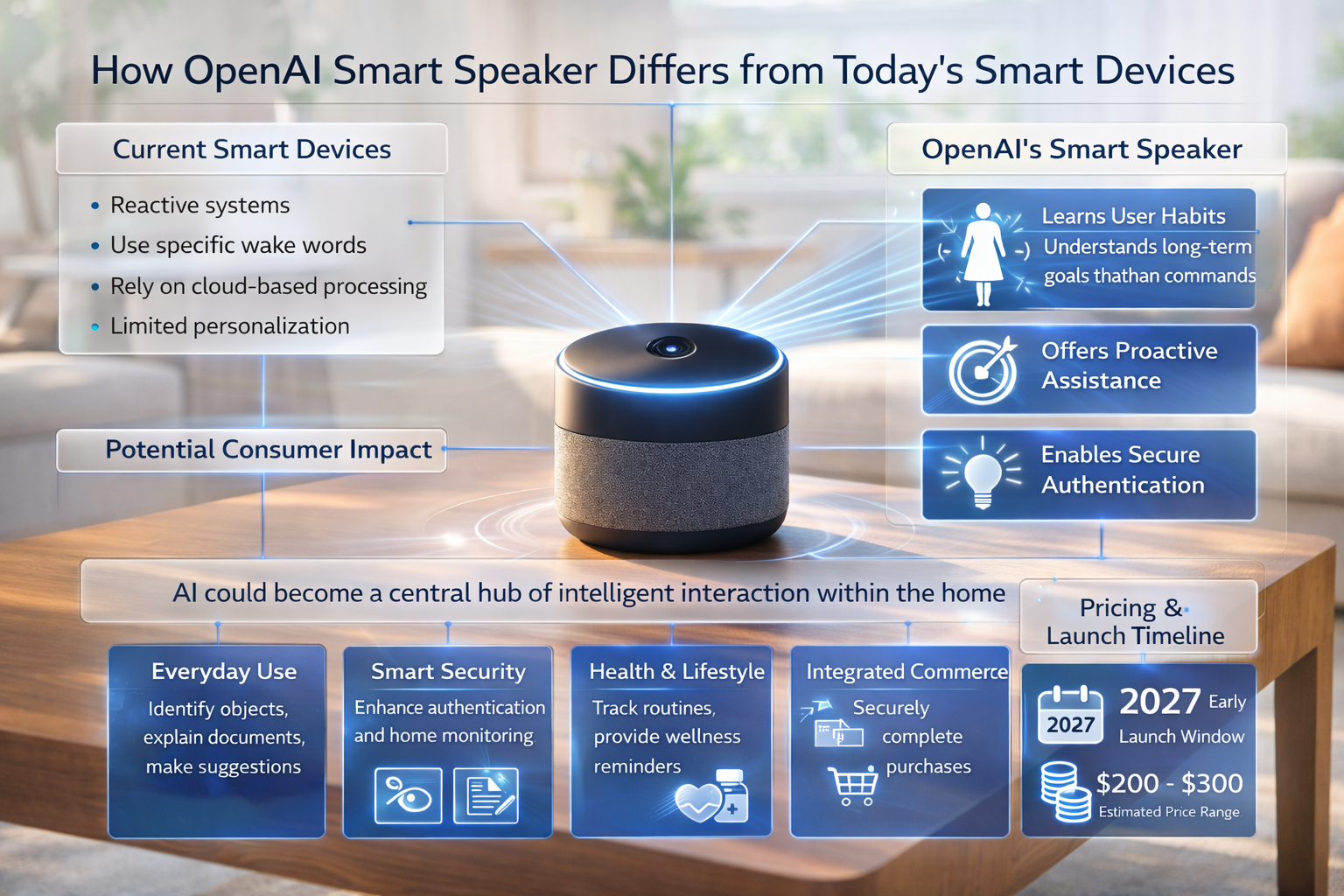
Projected to launch no earlier than 2027 and expected to fall within the $200 to $300 price range, the smart speaker is reportedly being designed to go far beyond traditional voice assistance. The inclusion of a camera capable of recognizing objects and detecting environmental cues suggests that OpenAI aims to create a system that interprets both visual and audio context.
Additionally, facial authentication technology — comparable to Face ID — could allow secure access, personalized responses, and even authenticated purchases. Instead of simply answering questions, the device may be able to execute actions securely on a user’s behalf.
Why This Matters: AI That Sees and Interacts
For years, AI assistants have operated primarily through voice and text. While effective for simple tasks, they lack awareness of who is speaking, what is happening in the room, or how the surrounding environment influences intent.
OpenAI’s reported approach could represent a shift from reactive AI to contextual intelligence.
Contextual Awareness Through Vision
By incorporating a camera, the smart speaker would not only hear commands but also interpret visual information. This could enable capabilities such as:
-
Recognizing objects in the environment
-
Anticipating user needs based on surroundings
-
Offering proactive reminders or suggestions
-
Personalizing responses depending on who is present
This evolution from voice-only interaction to multimodal intelligence could significantly enhance natural communication between humans and machines.
Inside the Hardware Strategy: Beyond a Single Device
OpenAI’s hardware ambitions appear to extend beyond just a smart speaker. The initiative is reportedly part of a broader push into physical products, strengthened by the acquisition of Jony Ive’s startup in 2025.
While the smart speaker may be the first device to reach consumers, other reported concepts include:
-
Smart glasses
-
A smart lamp
-
Wearable AI devices
These potential products suggest a long-term vision to embed AI into daily life, moving intelligence off screens and into physical environments.
How It Compares to Today’s Smart Devices
Current smart assistants are largely reactive systems. They require specific wake words and predefined commands, and they typically rely on cloud-based processing with limited personalization.
OpenAI’s proposed device could differ in several important ways:
-
Learning user habits over time
-
Understanding long-term goals rather than single commands
-
Offering proactive assistance
-
Enabling secure authentication for purchases or transactions
Rather than functioning as a secondary gadget, the device could become a central hub of intelligent interaction within the home.
This development may represent a third pillar of personal computing — beyond smartphones and laptops — where AI operates continuously in the background as an intelligent companion.
Pricing and Launch Timeline
Reports suggest a launch window no earlier than early 2027. The estimated $200 to $300 price range positions the device within premium consumer electronics territory.
However, challenges remain. Production complexity, privacy safeguards, and consumer trust will heavily influence adoption. Competitors also have time to innovate and respond before OpenAI enters the market.
Potential Consumer Impact
If OpenAI’s smart speaker launches as described, it could reshape everyday interactions.
Everyday Use
The device may move beyond basic tasks such as playing music or checking the weather. Users could potentially:
-
Ask the system to identify objects
-
Request explanations of documents or items in view
-
Receive suggestions without issuing explicit commands
Smart Security
With facial recognition and environmental awareness, the device could enhance smart home security systems through improved authentication and monitoring.
Health and Lifestyle Support
Environmental data interpretation might allow the system to:
-
Track routines
-
Provide wellness reminders
-
Anticipate scheduling needs
Integrated Commerce
Secure authentication could enable users to complete purchases directly through the device, streamlining online transactions.
Challenges and Concerns
Despite its potential, such a device raises important questions.
Privacy and Data Governance
A camera-equipped smart speaker introduces legitimate concerns:
-
Who owns and controls collected data?
-
Where is information stored?
-
How is it protected from misuse?
Clear policies and strong encryption practices will be essential to build user trust.
Security Risks
Biometric systems must be protected against spoofing and unauthorized access. Any vulnerability could undermine consumer confidence.
User Comfort and Adoption
Not all users are comfortable with always-on cameras inside their homes. Adoption may depend on transparency and optional controls.
The Broader Shift: AI as a Physical Companion
OpenAI’s potential move into hardware represents more than a new gadget. It signals the evolution of artificial intelligence from a tool accessed through screens to a contextual presence embedded within physical spaces.
If successful, this smart speaker could mark the beginning of a new era in consumer AI — one where intelligence is ambient, proactive, and deeply integrated into daily routines.
Whether it becomes a defining device of the decade or simply a first step toward broader innovation, one conclusion is clear: the transition from software-based AI to embodied, contextual systems has begun.


 Travel
  Studies
  Food
Food  Fashion
  Technology
  Health



All Comments (0)