

The integration of Meta AI into the Meta Quest 3 marks a turning point in immersive technology. No longer just a VR headset, Quest is evolving into an intelligent mixed reality companion powered by advanced language models, computer vision, and spatial computing. This shift signals the beginning of AI-first spatial computing—where digital environments respond naturally to human conversation and context.
The world of immersive technology is entering a new chapter with the integration of Meta AI into the Meta Quest 3 ecosystem. What was once a powerful standalone virtual reality headset is now evolving into an intelligent mixed reality companion. By embedding advanced AI capabilities directly into its hardware, Meta Platforms is reshaping how users interact with digital environments—making experiences more conversational, personalized, and context-aware.
This shift is not just an upgrade; it represents the beginning of AI-first spatial computing.
The Evolution of Quest: From Gaming to Intelligent Computing
When Quest devices first launched, they revolutionized VR by eliminating cables and external sensors. Users could move freely, explore immersive games, and experience virtual worlds with unprecedented convenience. Over time, improvements such as hand tracking and full-color passthrough expanded possibilities into mixed reality.
Now, with Meta AI integrated, the headset moves beyond entertainment. It becomes a computing device that understands natural language, analyzes surroundings, and responds intelligently. Instead of navigating static menus, users can simply speak and receive meaningful, contextual assistance without leaving their immersive environment.
This marks the transformation of Quest from a VR device into a spatial computer powered by AI.
What Meta AI Brings to Mixed Reality
Meta AI functions as a conversational assistant embedded directly within the Quest interface. Unlike traditional voice assistants that rely solely on scripted responses, Meta AI leverages advanced language models capable of understanding intent, context, and follow-up questions.
Inside the headset, this means users can ask questions about what they are seeing, request summaries of documents, seek explanations of complex topics, or even get help organizing tasks. Because the Quest headset includes outward-facing cameras and spatial mapping technology, the AI can interpret elements of the physical environment and blend that understanding with user requests.
The result is a system that feels responsive and aware rather than static and mechanical.
Context-Aware Spatial Intelligence
Mixed reality allows digital objects to coexist with the real world. With Meta AI layered on top, these digital objects become smarter and more adaptive.
The headset can interpret room dimensions, recognize surfaces, and position virtual screens intelligently. If a user is working at a desk, the AI can suggest optimal placement for windows or tools. If someone is learning a new skill, step-by-step guidance can appear directly in their field of vision, aligned with real-world objects.
This contextual awareness enhances immersion while making interactions more intuitive and productive.
Breaking Language Barriers in Virtual Spaces
Virtual environments are inherently global. Users from different countries and cultures gather in shared digital spaces, often facing language barriers that limit communication. Meta AI addresses this challenge by introducing real-time language interpretation within immersive experiences.
Through live speech translation and captioning, users can communicate across languages more naturally. In social VR platforms like Horizon Worlds, this feature has the potential to foster deeper global collaboration and more inclusive communities. Conversations that once required external translation tools can now unfold seamlessly inside the headset.
This development expands the social reach of VR beyond traditional linguistic boundaries.
Smarter Social Interactions
AI integration enhances social VR by making interactions more dynamic and engaging. Intelligent non-player characters powered by language models can respond conversationally, creating more lifelike virtual worlds. For creators, AI-assisted tools simplify environment design and storytelling. Instead of manually constructing every element, creators can describe ideas and allow AI systems to help generate immersive spaces.
This accelerates development cycles and opens the door for a broader community of creators to participate in building virtual experiences. As a result, the metaverse vision becomes more accessible and scalable.
Productivity in an Infinite Workspace
Beyond entertainment and social interaction, Meta AI enhances productivity within mixed reality. Users can create expansive virtual workspaces filled with floating monitors, collaborative tools, and reference materials. With AI assistance, these workspaces become smarter.
The assistant can summarize documents, draft emails, generate outlines, and explain complex data without interrupting immersion. Instead of switching between physical devices, users can rely on a unified spatial interface supported by AI. This reimagines how digital work might look in the future—less confined to screens and more integrated into three-dimensional environments.
Personalization and Adaptive Experiences
Meta AI adapts to user behavior over time, offering recommendations tailored to individual interests. Whether someone primarily uses Quest for fitness, gaming, creativity, or work, the system can surface relevant content and adjust settings accordingly.
This level of personalization ensures that the headset feels uniquely suited to each user rather than functioning as a one-size-fits-all device. As AI continues learning within privacy boundaries, immersive experiences become more aligned with personal preferences and routines.
Accessibility and Inclusion
AI-driven features significantly enhance accessibility within immersive environments. Voice commands reduce reliance on manual controls, while live captions assist users with hearing impairments. Real-time translation broadens participation for non-native speakers. Contextual explanations help newcomers navigate complex interfaces more comfortably.
These capabilities ensure that mixed reality becomes more inclusive and approachable, helping drive mainstream adoption.
The Technical Foundation Behind the Experience
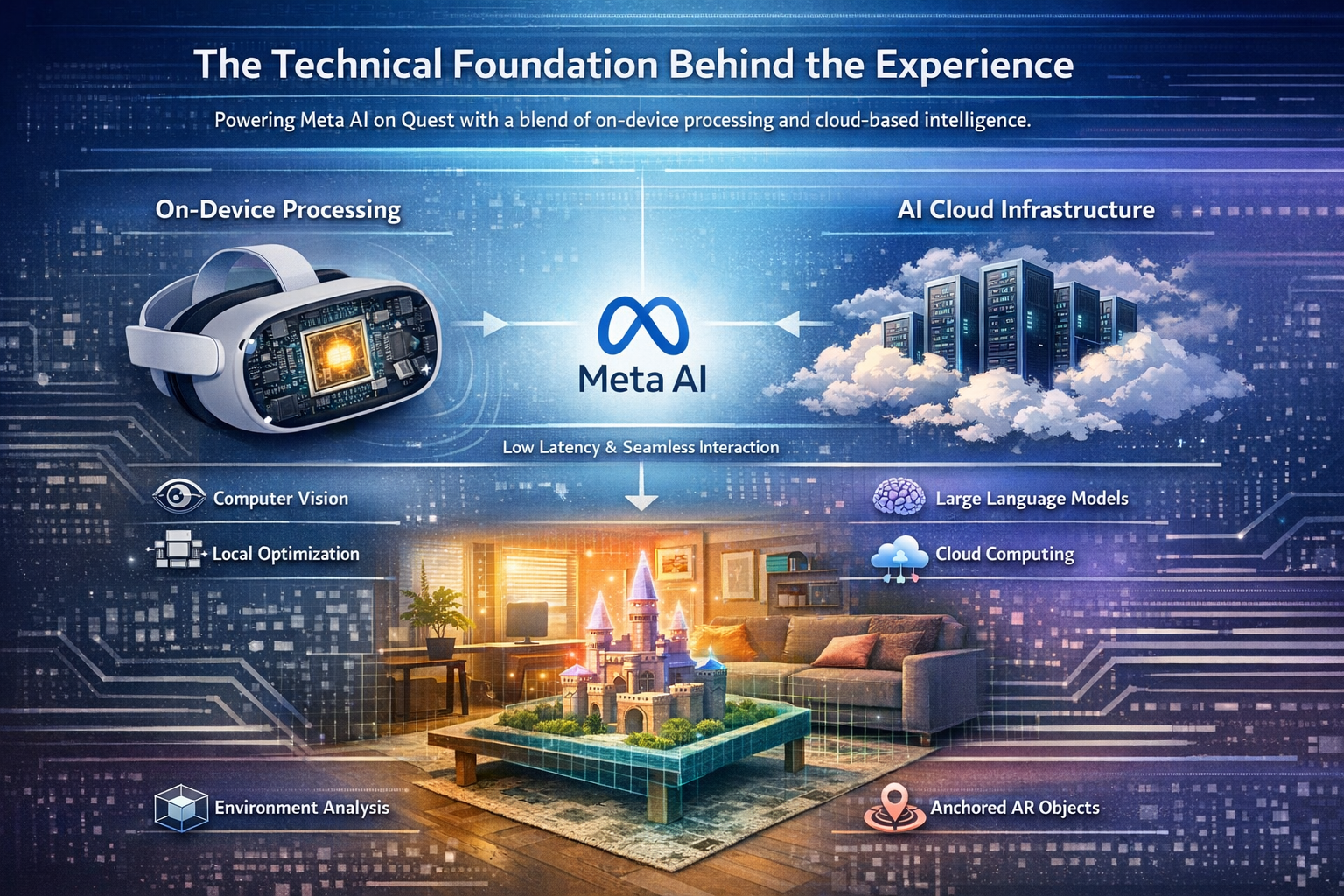
The seamless integration of Meta AI into Quest relies on a blend of on-device processing and cloud-based AI infrastructure. Large language models power conversational understanding, while computer vision algorithms interpret the environment. Spatial mapping technology anchors digital objects accurately within the physical world.
By combining hardware optimization with advanced AI models, Meta ensures that responses feel immediate and natural. Low latency is crucial in immersive environments, and the balance between local processing and cloud intelligence maintains fluid interactions.
Enterprise and Educational Potential
The impact of AI-enhanced mixed reality extends beyond consumers. In corporate settings, virtual collaboration spaces equipped with real-time translation can connect global teams more effectively. Training simulations can incorporate AI guidance, providing real-time feedback and contextual support.
In education, students can interact with immersive lessons enhanced by AI explanations and dynamic visualizations. From medical training to engineering design, the possibilities for professional application are expansive.
The Future of AI-First Spatial Computing
The integration of Meta AI into Quest signals a broader transformation in computing interfaces. Traditional devices rely on flat screens and keyboard inputs. Spatial computing, powered by AI, allows digital information to exist naturally within our surroundings.
As AI models continue to advance, mixed reality devices may evolve into everyday companions—assisting with tasks, facilitating communication, and enhancing creativity. The boundaries between physical and digital environments will continue to blur, guided by intelligent systems that understand context and intent.
Conclusion: A New Era for Immersive Technology
The introduction of Meta AI on Quest headsets marks a pivotal milestone in the journey of immersive technology. By combining advanced language models, computer vision, and spatial computing, Meta has transformed the Quest ecosystem into a smart mixed reality assistant.
What began as a gaming innovation is becoming a comprehensive computing platform—capable of enhancing productivity, creativity, social connection, and accessibility. As AI and mixed reality converge, the future of interaction moves beyond screens and into intelligent, immersive spaces that respond naturally to human conversation.
The era of passive virtual experiences is ending. In its place emerges a new generation of smart, adaptive mixed reality powered by AI.


 Travel
  Studies
  Food
Food  Fashion
  Technology
  Health




All Comments (0)