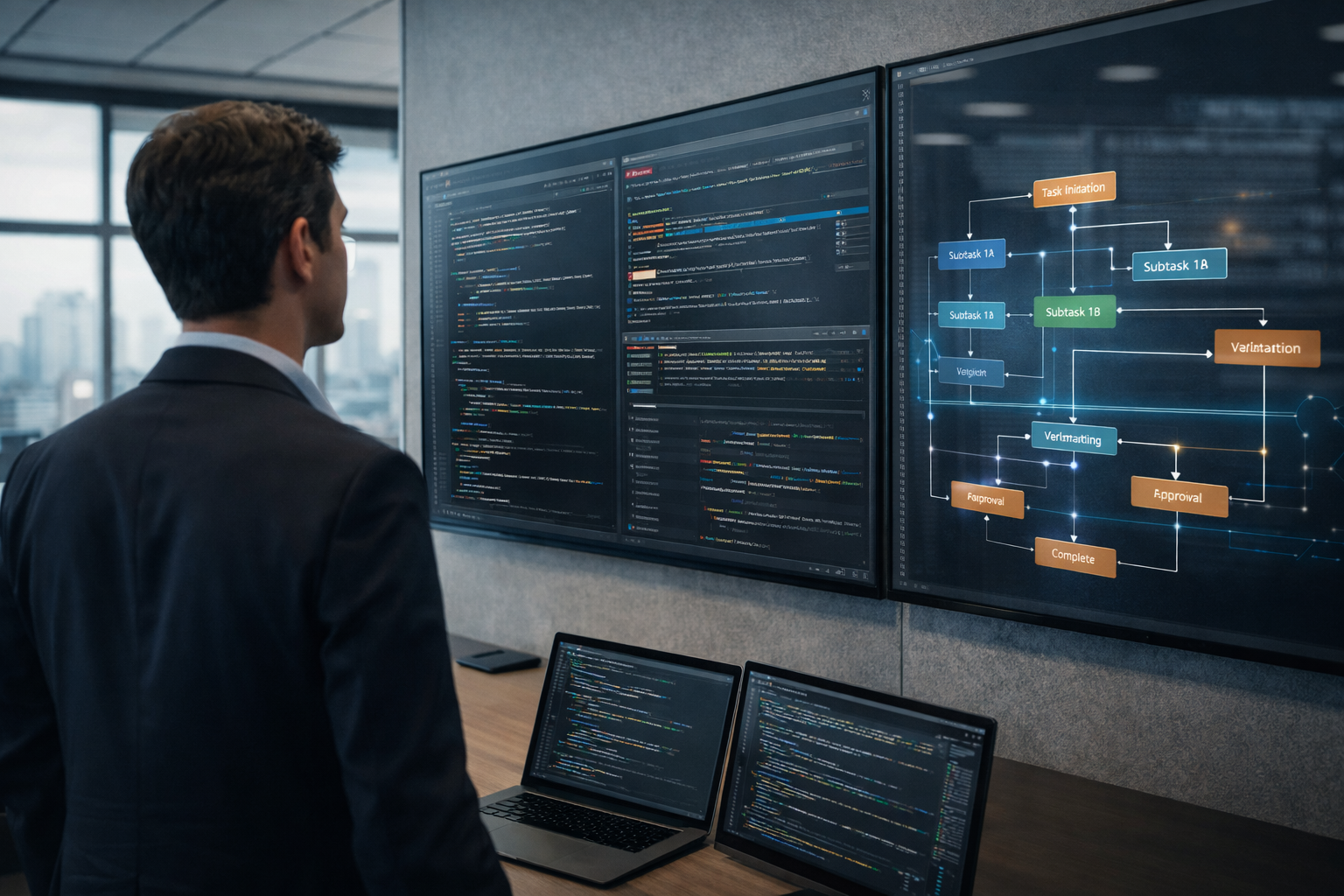

Anthropic’s surprise AI coding breakthrough is redefining how software is built, shifting AI from a simple assistant to an autonomous collaborator. The rise of Claude Code signals a major turning point in the global AI race and the future of work.
In the fiercely competitive world of artificial intelligence, dominance is usually associated with massive funding rounds, billion-parameter models, and headline-grabbing partnerships. But sometimes, the most powerful transformation begins quietly — inside an engineering lab, as a practical tool built to solve an internal problem.
That’s the story behind Anthropic and the unexpected rise of its AI coding system, widely known as Claude Code. What began as a productivity experiment evolved into a product that reshaped Anthropic’s business trajectory, accelerated revenue growth, and intensified the global AI arms race.
This wasn’t just another incremental AI improvement. It represented a deeper shift — from AI as a helpful assistant to AI as an autonomous collaborator.
A Company Built on Safety — and Surprises
Anthropic was founded with a clear philosophical mission: build advanced AI systems that are powerful, reliable, and aligned with human values. The company gained attention through its Claude language models, which compete directly with other frontier AI systems.
But Claude Code was not initially intended to be the centerpiece of its strategy.
Inside the company, engineers were experimenting with ways to improve internal workflows. One of the contributors, engineer Boris Cherny, helped shape a system capable of writing and refining code with remarkable consistency. At first, it functioned as a productivity booster for Anthropic’s own teams.
What changed everything was how well it worked.
Even leadership, including CEO Dario Amodei, reportedly did not anticipate the scale of impact the tool would have. Engineers began relying on it daily. It wasn’t just generating snippets — it was completing tasks end-to-end.
When the company decided to release it publicly, the response exceeded expectations.
The Leap From Assistance to Autonomy
Most earlier AI coding tools functioned like smart autocomplete systems. They were useful, but limited. Developers still needed to guide every step.
Claude Code demonstrated something different.
It could:
-
Interpret complex instructions
-
Break tasks into logical steps
-
Write structured code
-
Debug and refine outputs
-
Continue working autonomously for extended sessions
This autonomy is what made it revolutionary. Developers could assign meaningful chunks of work and focus on higher-level design decisions while the AI handled execution.
In practice, this changed workflows dramatically. Instead of typing every line, engineers began reviewing and directing AI output. The relationship shifted from “human instructs tool” to “human supervises collaborator.”
That distinction matters. It suggests a future where AI is not just augmenting productivity but transforming how work is organized.
Rapid Adoption Across the Industry
The success of Claude Code was not confined to startups or hobbyist developers. Enterprise engineering teams quickly recognized its value.
Companies such as Spotify reportedly integrated AI coding assistance into internal workflows. Teams embedded it into communication platforms, enabling AI to participate directly in development cycles.
For startups, the implications were even more dramatic. Small teams could now build products at speeds previously achievable only by larger engineering departments. This leveled the playing field and intensified competition.
Revenue growth followed swiftly. What started as a side project evolved into one of Anthropic’s most commercially impactful offerings. Investors and industry observers began to see the company not only as a research powerhouse but as a practical technology provider with real-world traction.
A Signal to the Broader AI Market
The rise of AI coding tools sends a powerful message to the technology industry: practical utility drives adoption faster than theoretical capability.
While large language models often dominate headlines for conversational intelligence or creative outputs, coding tools demonstrate measurable economic value. Businesses can calculate how much time they save. Developers can quantify productivity gains.
This clarity accelerates adoption.
It also pressures competitors. Other AI firms must now match or exceed these capabilities to remain relevant. The competitive bar has risen — not just in model size or benchmark scores, but in autonomy and real-world effectiveness.
Rethinking Software Development
For decades, software development has followed a relatively stable structure: design, write code, test, debug, deploy. AI tools compress this cycle dramatically.
With advanced coding assistants:
-
Prototypes can be generated in minutes.
-
Refactoring tasks become automated.
-
Documentation can be created instantly.
-
Testing scripts can be produced alongside core logic.
Developers increasingly operate as system architects rather than manual implementers.
This shift does not eliminate human involvement — it elevates it. Strategic thinking, creativity, and ethical oversight become more central.
The productivity multiplier effect may redefine company scaling. Instead of hiring large teams to increase output, organizations might focus on smaller, highly skilled groups empowered by AI.
The Economic Ripple Effect
AI-driven coding is not just a technical innovation; it is an economic one.
If companies can ship products faster, they can:
-
Reduce time-to-market
-
Lower development costs
-
Experiment more aggressively
-
Respond to user feedback more rapidly
These advantages translate into competitive leverage.
Traditional software firms that resist AI integration risk being outpaced by AI-native competitors. Meanwhile, startups can achieve in months what once required years.
This dynamic creates both opportunity and disruption. Markets may consolidate around companies that successfully integrate AI into their workflows.
Workforce Transformation: Threat or Evolution?
The question inevitably arises: what happens to software engineers?
History offers perspective. Each wave of automation has shifted job roles rather than eliminating entire professions. Spreadsheets did not remove accountants. CAD tools did not replace architects.
Similarly, AI coding systems are likely to transform — not erase — the role of developers.
Skills that may grow in importance include:
-
System architecture
-
Prompt engineering and AI collaboration
-
Quality assurance and validation
-
Ethical and security oversight
Entry-level coding tasks may become more automated, potentially raising the bar for new developers. However, the expansion of AI-driven industries may also create new roles that did not previously exist.
Expanding Beyond Code
While Claude Code gained attention for software development, its underlying technology has broader implications.
The same reasoning capabilities that enable structured code generation can apply to:
-
Legal document drafting
-
Financial modeling
-
Scientific research assistance
-
Enterprise process automation
Anthropic’s broader strategy likely includes expanding into these domains. As AI systems demonstrate reliability in one structured field, they can adapt to others.
This cross-industry potential strengthens the company’s position in the global AI race.
Responsibility in the Age of Autonomous AI
With increased autonomy comes increased responsibility.
Autonomous coding tools must:
-
Avoid generating insecure or vulnerable code
-
Respect intellectual property boundaries
-
Operate transparently
-
Remain aligned with human oversight
Anthropic’s focus on alignment and safety positions it to address these concerns proactively. But the industry as a whole must develop standards and best practices to ensure responsible deployment.
The stakes are high. Software underpins infrastructure, healthcare, finance, and communication. Reliability is not optional.
A New Competitive Landscape
Anthropic’s coding breakthrough has reshaped perceptions of what a frontier AI company looks like.
Success is no longer measured solely by research milestones or benchmark performance. It is measured by how effectively AI integrates into daily workflows and generates economic value.
This shift may influence how investors evaluate AI startups and how enterprises select technology partners.
The companies that succeed will be those that combine:
-
Advanced research
-
Practical application
-
Scalable infrastructure
-
Responsible governance
Anthropic’s trajectory demonstrates how quickly an experimental tool can redefine a company’s identity.
The Broader Meaning of the Breakthrough
At its core, this story reflects a fundamental transition in artificial intelligence.
We are moving from:
AI as a conversational novelty
to
AI as an operational partner
That shift has profound implications. It alters productivity curves, workforce dynamics, and competitive hierarchies.
The surprise is not just that Anthropic built a powerful coding assistant. It is that such tools can emerge organically within innovative environments and rapidly transform industries.
Conclusion: The Quiet Revolution in Code
The rise of Claude Code within Anthropic illustrates how transformative breakthroughs often begin modestly. A tool designed to streamline internal workflows became a catalyst for global recognition and commercial success.
More importantly, it marked a turning point in AI capability. Coding assistants evolved from supportive features into autonomous collaborators capable of executing complex tasks.
As AI continues to mature, similar breakthroughs may emerge across industries. The lesson is clear: innovation thrives where experimentation meets real-world application.
Anthropic’s journey is not merely about one product. It is about the dawn of a new working relationship between humans and machines — one where intelligence is shared, productivity is amplified, and the boundaries of possibility continue to expand.

 Travel
  Studies
  Food
Food  Fashion
  Technology
  Health





All Comments (0)