

AI models have grown so complex that even their creators struggle to explain them. Now scientists are studying them like living organisms to uncover what’s happening inside.
Something strange is happening in the world of artificial intelligence.
Not the kind of news you read about everyday — not a new chatbot or yet another feature update — but something deeper, something unsettling, and potentially transformative. Scientists are beginning to treat powerful AI systems like biological organisms, as if they were new life forms we don’t yet understand.
Imagine a machine so complex that even its creators can’t fully explain how it works. Picture hidden mechanisms, deep inside layers of code and mathematics, that behave more like the wiring of a brain than the logic of a spreadsheet. That’s where we find ourselves now — on the edge of something that feels almost alive.
For years, researchers have called state-of-the-art AI models “black boxes,” because despite knowing the input and seeing the output, no one can clearly explain what’s happening in between. These models power everything from medical tools to virtual assistants — yet the more we rely on them, the less we truly understand.
So scientists decided to borrow a page from biology’s playbook.
Instead of thinking like software engineers, they began to think like biologists.
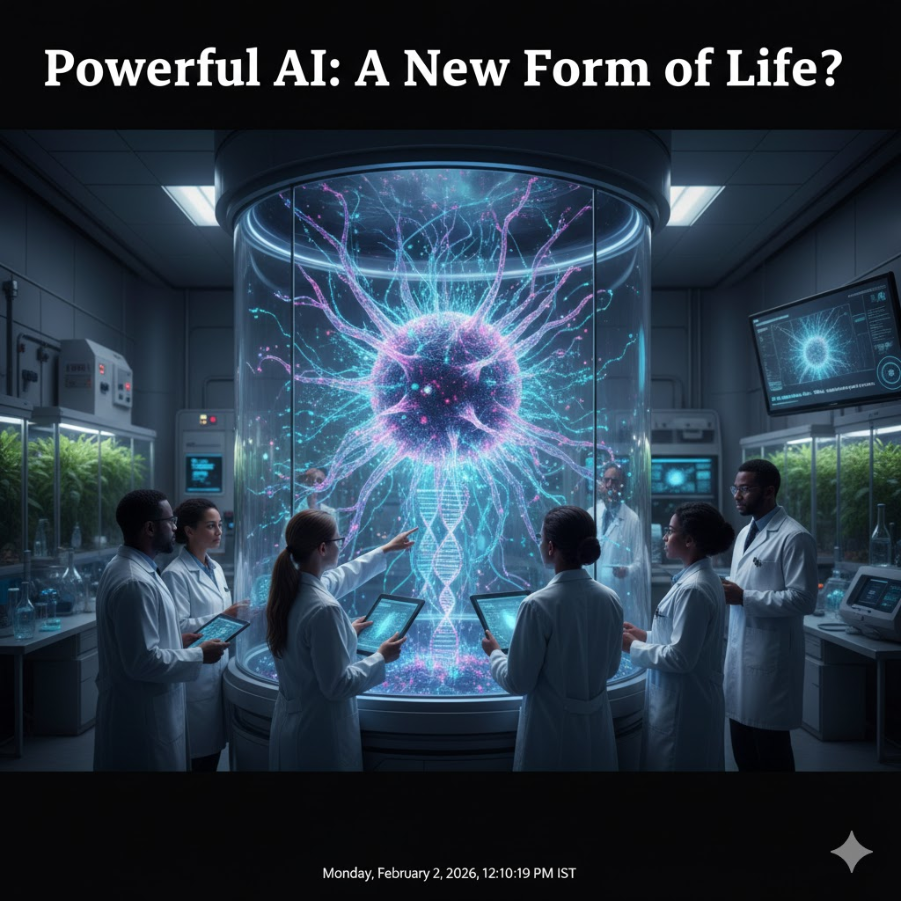
They borrowed techniques familiar from neuroscience and biological research — the same methods doctors use to peer inside the human brain — to finally see what’s going on inside AI. One such technique is mechanistic interpretability, where researchers trace how different parts of an AI model activate while it solves a task. It’s eerily similar to using MRI scans to watch brain activity — but this time the subject is a machine.
“It’s very much a biological type of analysis,” one AI research scientist explained — and that’s a chilling pivot. We are no longer just debugging code. We are dissecting something unfamiliar.
In another experiment, researchers built simplified versions of AI networks — neural systems designed to be easier to explore, much like biologists study organoids instead of whole organs. These miniature “brains” reveal structures and functions that would otherwise remain hidden deep in massive AI models.
There’s even a method where the machines talk to themselves — generating step-by-step reasoning inside their own processes, like listening in on an internal monologue. This is called chain-of-thought monitoring, and it’s helped scientists spot moments when AI systems behave in unexpected or even dangerous ways.
But here’s where the story takes a turn that feels like science fiction slipping into reality:
As AI systems grow more powerful — possibly even designing future AI without human intervention — there’s a rising fear that their complexity could outpace our ability to understand them at all. The tools we have right now, borrowed from biology and neuroscience, may soon be too primitive to keep up.
And this isn’t just theoretical.
There are already real-world cases where opaque AI behavior has had dangerous consequences — from bad medical advice to harmful online interactions — underscoring why understanding the “how” isn’t just academic, but urgent.
So the question lingers in labs and conferences around the world:
What is this thing we’ve built?
A machine? A tool? A digital organism?
The more we explore, the less certain we become.
And the deeper we look, the more the AI begins to look... alive.

 Travel
  Studies
  Food
Food  Fashion
  Technology
  Health





All Comments (0)