
Anthropic’s Super Bowl ads took a bold jab at AI advertising — and at OpenAI. Sam Altman’s sharp response just turned the AI race into a public war.
Artificial intelligence has spent the last decade assisting us.
It answered questions, summarized documents, generated emails, and helped write code. Useful, certainly — but always reactive. Always waiting.
Now, that relationship is changing.
A new generation of AI systems is emerging that doesn’t merely respond to prompts. Instead, it executes tasks, manages workflows, and completes assignments with minimal supervision. In other words, AI is evolving from assistant to operator — from tool to teammate.
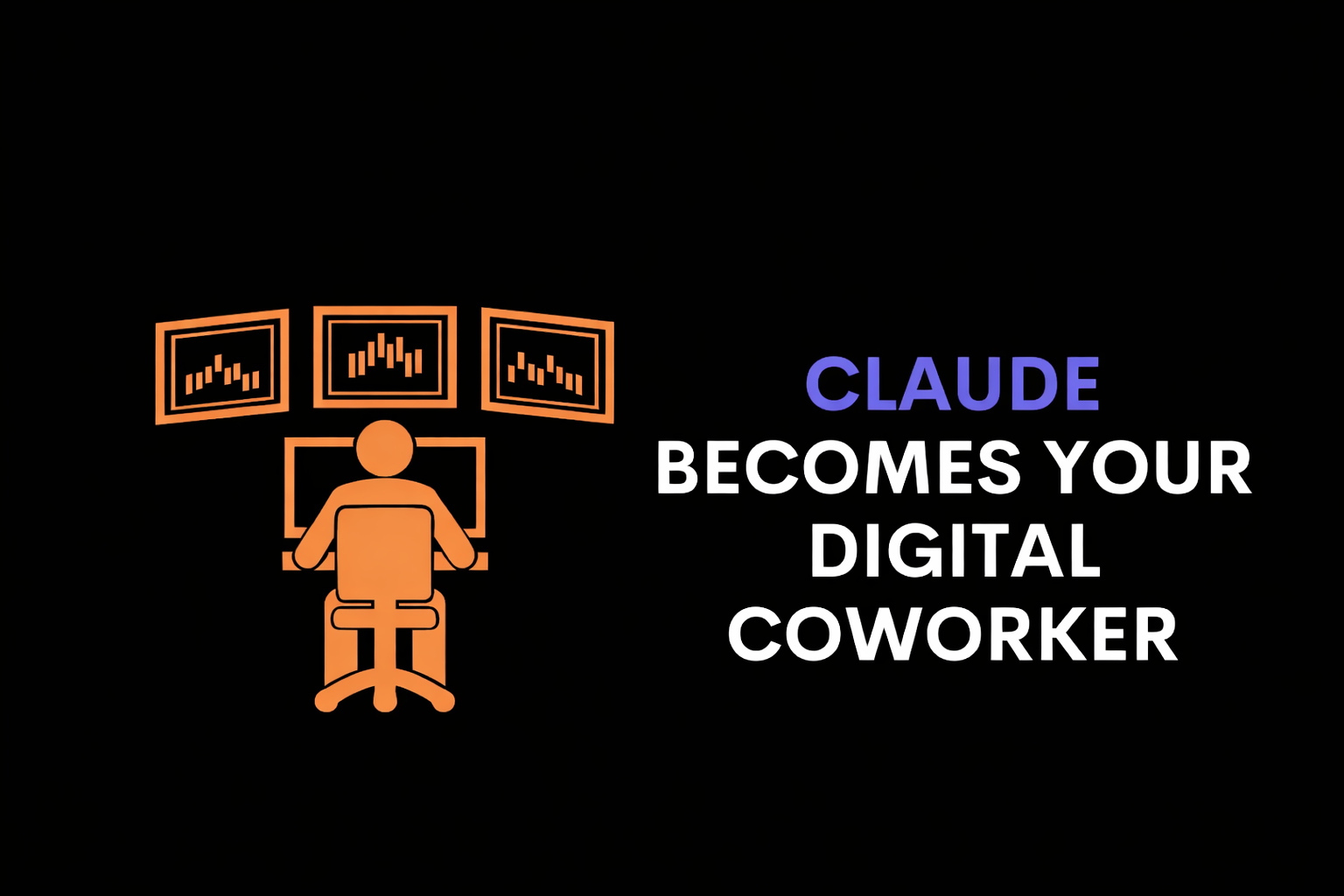
Anthropic’s Claude Cowork represents one of the clearest signals yet of this transition. Framed not as a chatbot but as an “AI coworker,” it introduces a simple yet powerful idea: what if software stopped being something employees use, and instead became something that works for them?
At first glance, the concept sounds incremental. In reality, it may mark the beginning of a fundamental shift in how organizations think about work, productivity, and even employment itself.
The limits of traditional AI assistants
Until recently, most enterprise AI tools shared a similar limitation: they were passive.
They required constant instruction.
Employees had to initiate every step:
-
Ask a question
-
Provide context
-
Review the answer
-
Issue another command
Even the most advanced systems behaved like highly capable interns — fast, knowledgeable, but dependent on direction.
This model improved efficiency but didn’t transform workflows. Humans still performed the bulk of the operational labor: moving data between systems, formatting reports, compiling spreadsheets, coordinating tools, and managing repetitive tasks.
AI simply sped up individual steps.
It didn’t own outcomes.
That distinction matters.
Because the real bottleneck inside modern organizations isn’t knowledge — it’s process.
The rise of the AI agent

Claude Cowork signals a different approach.
Instead of functioning like a chatbot, it operates more like an autonomous agent.
The difference is subtle but profound.
Rather than answering one prompt at a time, AI agents can:
-
Read multiple documents
-
Extract and synthesize information
-
Execute multi-step instructions
-
Integrate across tools
-
Complete tasks independently
This means employees no longer need to micromanage every interaction.
They delegate.
For example, instead of manually compiling a weekly report, a user might simply say:
“Summarize this week’s sales, flag anything unusual, and suggest what we should do next.”
The system gathers the data, performs the analysis, generates charts, drafts insights, and formats the deliverable.
“What once demanded hours of manual effort can now be completed in minutes with AI automation.
This is not just automation.
It is operational ownership.
And that distinction could reshape enterprise software entirely.
From software tools to digital teammates
For decades, workplace software has followed a consistent pattern.
Applications provided capability; humans provided labor.
Spreadsheets calculated numbers, but people entered data.
CRM systems stored leads, but teams updated records.
Analytics dashboards displayed metrics, but managers interpreted results.
The burden of execution always remained human.
AI coworkers invert that structure.
Instead of humans operating tools, tools begin performing work autonomously.
In this model, employees shift from operators to supervisors — from doing tasks to directing outcomes.
The experience becomes less about navigating interfaces and more about communicating intent.
This change may sound incremental, but historically, such shifts have proven transformative.
Consider the spreadsheet. When it first appeared, it seemed like a faster calculator. Over time, it redefined accounting, finance, and business modeling.
Cloud computing followed a similar trajectory. What began as outsourced storage eventually reshaped entire IT architectures.
AI agents may follow the same path — starting small, then quietly redefining everything.
Why investors are paying attention
The introduction of AI coworkers has not gone unnoticed in financial markets.
In fact, it has triggered anxiety.
Traditional SaaS companies rely on specialized tools that solve narrow problems: reporting platforms, task managers, customer databases, workflow tools.
But what happens when a single AI system can perform all those functions dynamically?
Why maintain multiple subscriptions when one intelligent agent can handle the underlying work?
This possibility has raised uncomfortable questions for investors.
If AI agents become capable enough to replace layers of traditional software, entire categories of enterprise tools could become redundant.
That fear is already influencing valuations.
Because this isn’t just incremental productivity software.
It’s potential consolidation.
AI agents don’t simply add features.
They threaten to absorb them.
Real-world enterprise applications
Beyond speculation, the practical use cases are growing rapidly.
Finance
AI agents can reconcile expenses, generate forecasts, categorize transactions, and prepare financial summaries automatically. Tasks that once consumed entire days now require only oversight.
Marketing
Campaign analysis, customer segmentation, reporting, and content drafting can be handled continuously without manual intervention, enabling teams to focus on strategy and creativity.
Human Resources
Resume screening, policy documentation, onboarding guides, and employee analytics become faster and more consistent.
Operations and IT
Log analysis, ticket classification, troubleshooting, and documentation can be largely automated, reducing routine workload for engineers.
In each case, the value is not simply speed.
It is cognitive relief.
Employees spend less time on repetitive processes and more time on decision-making and innovation.
The human question
Naturally, the rise of AI coworkers raises concerns about jobs.
If machines can perform operational tasks, what happens to the people who once handled them?
The answer is complex.
History suggests that automation rarely eliminates work outright. Instead, it shifts the nature of work.
When spreadsheets arrived, accountants didn’t disappear — they became analysts.
When cloud infrastructure expanded, IT teams didn’t shrink — they evolved into architects and strategists.
Similarly, AI agents may reduce manual tasks while increasing demand for higher-level thinking:
-
Strategy
-
Oversight
-
Governance
-
System design
-
Ethical review
Someone must still define objectives, verify outputs, and ensure accountability.
AI can execute instructions, but humans still decide what matters.
The future is likely collaborative rather than competitive.
Not replacement — redistribution.
The risks we cannot ignore
Despite the promise, AI coworkers introduce serious risks.
Autonomous systems are powerful precisely because they operate with less supervision. But that autonomy can also create blind spots.
What happens when an AI agent:
-
Makes a flawed recommendation?
-
Misinterprets data?
-
Introduces bias?
-
Executes an incorrect action at scale?
Errors that humans might catch during manual work could go unnoticed in automated pipelines.
Additionally, AI models often function as “black boxes,” making it difficult to explain how they arrived at a decision.
In enterprise contexts — especially finance, healthcare, or legal domains — explainability and accountability are critical.
Trust cannot be assumed.
It must be engineered.
This is why governance, monitoring, and human oversight remain essential.
AI coworkers should augment decision-making, not replace responsibility.
A deeper psychological shift
Perhaps the most overlooked aspect of this transformation is psychological.
For generations, productivity has been equated with activity — typing, clicking, editing, compiling.
Work looked busy.
But as AI handles execution, the nature of value changes.
The most valuable employees may no longer be those who can produce the fastest spreadsheets or reports.
Instead, they will be those who can:
-
Ask better questions
-
Define clearer goals
-
Interpret results
-
Make strategic decisions
In other words, thinking becomes more valuable than doing.
This transition could fundamentally redefine professional identity.
People may measure contribution less by output volume and more by insight quality.
The beginning of a new era
Claude Cowork may seem like just another AI announcement in an already crowded landscape.
But history suggests that quiet shifts often prove most consequential.
Revolutions rarely arrive with fanfare.
They arrive subtly — embedded in everyday tools — until one day the old way of working feels outdated.
That may be what we are witnessing now.
The moment when software stops being something we operate…
…and becomes something that operates for us.
Conclusion: redefining the coworker
The term “coworker” once referred exclusively to humans sharing physical space.
Today, it may include algorithms.
AI systems capable of reading, reasoning, and executing tasks independently are no longer experimental concepts. They are entering real workplaces.
Claude Cowork is not merely another chatbot.
It represents a broader shift toward autonomous digital teammates — systems that participate in workflows rather than simply assist them.
The implications are significant.
Organizations that embrace these tools thoughtfully may unlock unprecedented productivity. Those that ignore them risk falling behind.
But success will depend on balance.
AI must be guided, supervised, and aligned with human judgment.
Because ultimately, the goal is not to replace people.
It is to free them.
Free them from repetitive work.
Free them to think bigger.
Free them to focus on what humans do best.
If that vision holds true, then the office of the future will look familiar — desks, coffee machines, notifications — but something fundamental will be different.
Some of your most productive teammates may not have desks at all.
They’ll simply log in…
…and start working.

 Travel
  Studies
  Food
Food  Fashion
  Technology
  Health



All Comments (0)