

Two-Line Short Introduction New York lawmakers have introduced a pair of bills targeting AI-generated news and data centre growth, aiming to mandate transparent labeling and human review of AI-created media while considering a three-year pause on new data centre permits. These proposals reflect growing concerns over AI’s impact on journalism integrity, infrastructure demands, and energy sustainability.
In early February 2026, New York state legislators introduced a pair of groundbreaking bills aimed at regulating the use of artificial intelligence in media and managing the rapid growth of data centre infrastructure within the state. These dual initiatives reflect growing concerns about the ethical, economic, and environmental impact of advanced AI tools and the sprawling infrastructure that supports them.
The first bill — known as the New York Fundamental Artificial Intelligence Requirements in News Act (NY FAIR News Act) — would require any news article or newsroom content generated substantially or primarily by AI to be clearly labeled as such and to undergo human editorial review before publication. At the same time, a companion proposal seeks a three-year pause on permitting new data centres, a proposal motivated by climate, energy, and utility cost concerns associated with AI’s voracious infrastructure demands.
These legislative efforts come amid broader U.S. debates on how to govern artificial intelligence in a way that fosters innovation while safeguarding public trust, energy resources, and jobs. In this full exploration, we’ll unpack the bills, the driving forces behind them, expert reactions, and potential implications for the future of AI policy in New York and beyond.
Why New York Is Targeting AI News Content
Artificial intelligence has become deeply embedded in media workflows, with many publishers and news organizations using generative AI tools to draft articles, summarize briefs, or assist in investigative research. While these tools offer productivity gains, they also raise serious concerns about transparency, accuracy and accountability.
The proposed NY FAIR News Act mandates greater transparency in how artificial intelligence is used within journalism. Any article that is largely written or produced with the help of generative AI would need to include a clear, easy-to-notice disclosure informing readers that the content involves AI assistance.
Additionally, the legislation requires that all AI-supported material undergo thorough human oversight, with a qualified editor reviewing, verifying, and retaining full editorial authority before the story can be published.
Backers of the bill argue that AI-generated content, if left unlabeled, could blur the distinction between human journalism and automated outputs, creating uncertainty about credibility. This proposal is part of an effort to preserve traditional journalistic standards and maintain public confidence in news media, especially as the line between human reporting and AI assistance becomes increasingly difficult to discern.
The NY FAIR News Act also includes additional transparency requirements for newsroom staff, including disclosures on how AI is being employed within editorial processes and safeguards to protect sensitive or confidential information — such as journalistic sources — from being incorporated into AI datasets or shared with third parties.
Supporters suggest that these measures will empower readers to make informed decisions about the content they consume, while preserving the vital role of human oversight in journalism. At the same time, critics — including some free-press advocates — warn that mandated labels or government oversight could inadvertently infringe on editorial independence and introduce rigid compliance demands that are difficult to enforce in real time.
The Data Centre Freeze: Balancing Growth With Energy and Environmental Concerns
More than a dozen states, including New York, are now grappling with the challenge of managing the explosive growth of data centres — large facilities that house computing infrastructure for AI training, cloud computing, and digital services. These facilities draw massive amounts of electricity and water, contribute to spikes in electricity demand, and raise questions about environmental impact and local utility costs.
The second proposed bill — currently known as Bill S9144 — calls for a moratorium on new data centre permits for at least three years. During this period, state regulators would be tasked with conducting comprehensive studies into the environmental, economic, and energy implications of large data centres, including their impact on electricity grids, water resources, emissions and long-term planning requirements.
Supporters argue that the moratorium would provide New York regulators with crucial time to assess how best to balance economic growth driven by high-technology infrastructure with sustainable energy strategies and equitable cost structures for residents. The bill is partly a response to rapid increases in electric load requests, which have reportedly tripled within the past year, placing strain on utilities like Con Edison and leading to higher bills for consumers.
Environmental groups have welcomed the pause, saying it allows for environmental impact assessments that are overdue given the growth of the AI industry. Critics, however, contend that such a freeze could slow economic development, push data centre investment to states with less restrictive policies, and stifle innovation at a time when AI infrastructure is increasingly central to competitiveness.
Context: AI Policy and Regulation in the U.S.
The proposals in New York come against a backdrop of increasingly active legislative efforts to regulate AI at both state and national levels. While there is currently no comprehensive federal AI regulatory framework in the United States, several states have taken the lead in enacting AI transparency laws and safety requirements.
In December 2025, New York Governor Kathy Hochul signed the Responsible AI Safety and Education Act (RAISE Act), requiring developers of advanced AI models to publicly disclose safety measures and risk management strategies. This law is part of a broader push to ensure that AI systems deployed in the state meet basic accountability and transparency standards.
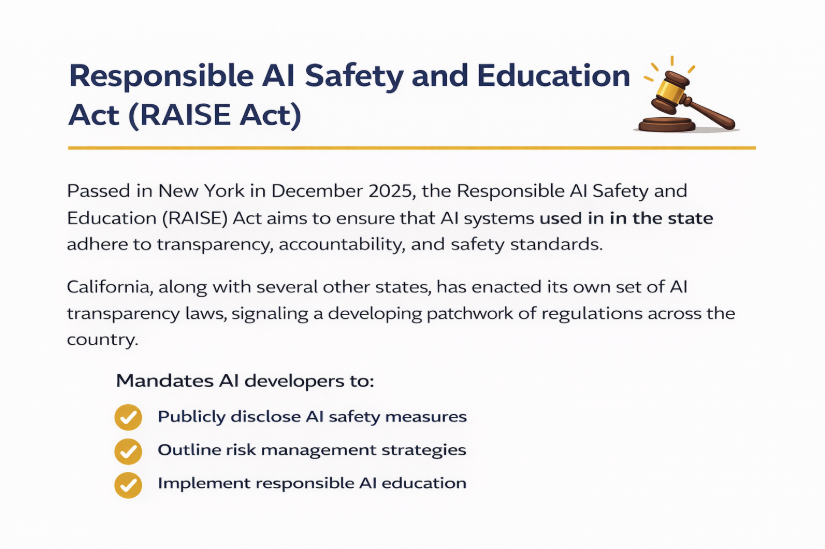
Other states, including California, have implemented their own AI transparency laws, while federal discussions continue over how to balance innovation with ethical considerations and national competitiveness. These developments underscore a patchwork landscape of AI regulation — where state policies may increasingly influence national norms, especially in the absence of comprehensive federal legislation.
Some federal proposals seek to create national AI safety standards, while others focus on sector-specific regulation (such as AI in healthcare or autonomous systems). The mix of state and federal efforts highlights the complexity of governing AI technologies that evolve rapidly and touch nearly every aspect of modern life.
Public and Industry Reactions
The proposed AI news labeling and data centre pause bills have sparked debate among journalists, technologists, privacy advocates and industry stakeholders.
Supporters of the labeling provisions argue that transparency should be a cornerstone of responsible AI integration into news media. They point to studies showing that audiences are often unaware when content has been generated or heavily influenced by machine learning models, increasing the risk of misinformation. By clearly marking AI-derived content and requiring human editorial oversight, supporters believe the public can better assess the reliability and intent of news reporting.
However, critics — including some First Amendment scholars and newsroom editorial leaders — caution that government-mandated labeling could risk infringing on editorial freedom. They argue that editorial standards and ethics — traditionally determined by independent newsroom processes — are better suited to ensure accuracy and integrity than state-imposed rules. This faction worries that well-intentioned regulation could unintentionally chill creativity or lead to over-compliance that slows down legitimate use of beneficial AI tools.
On the data centre moratorium, views are similarly mixed. Environmental advocates argue that a pause is necessary to assess and mitigate the energy and ecological footprint of these facilities, particularly in regions facing grid constraints and rising electricity costs. Other stakeholders — such as economic development advocates — warn that too strict regulation could discourage investment, slow job growth in tech sectors, and make New York less competitive relative to other states with more business-friendly policies.
National groups and industry players have also weighed in, with some tech and utility analysts calling for collaborative frameworks that consider both sustainable infrastructure planning and innovation drivers. The debate mirrors similar discussions across other states and countries as lawmakers wrestle with how to integrate large-scale computing needs with environmental and social policy priorities.
Potential Impacts on Media, Tech and AI Development
If enacted, the AI news labeling rules could fundamentally reshape how media organizations integrate AI into their editorial workflows. Newsrooms large and small would need to implement content tracking systems, audit trails, and editorial checks to comply with labeling and human review requirements. This could lead to new industry standards around AI use in journalism, potentially influencing other states or media markets that look to New York as a policy leader.
For data centre development, a three-year moratorium may pause some construction pipelines but also create a window for infrastructure planning, utility negotiations and environmental assessment. It could lead to new policies that balance technological progress with grid resilience and sustainability, and set precedents for how states manage energy-intensive sectors tied to AI growth.
Given New York’s significant role in finance, media, education and technology sectors, the state’s legislative moves may influence national conversations about how best to govern AI responsibly while supporting innovation and economic dynamism. These dual bills highlight broader questions about trust, transparency, environmental responsibility, consumer protection and the pace of technological adoption in modern society.
Conclusion
New York’s proposed AI regulation bills — requiring AI news labeling and human editorial oversight, along with a moratorium on data centre permits — mark a bold expansion of state-level tech policy in the United States. They reflect growing public interest in transparency, ethical AI use, and responsible infrastructure growth, while also igniting debate about the role of government in shaping the future of emerging technologies.

 Travel
  Studies
  Food
Food  Fashion
  Technology
  Health





All Comments (0)