

What if your AI didn’t just answer your questions — but actually completed your entire project from start to finish? Perplexity Computer aims to transform AI from a prompt-based assistant into a fully autonomous digital worker, capable of managing complex goals, coordinating multiple models, and delivering real outcomes. This could mark the beginning of a new era — where AI doesn’t just inform, but executes.
What if your AI didn’t just respond to your questions… but actually completed your projects?
Not drafts.
Not suggestions.
Not “Here’s a starting point.”
But the whole thing.
That’s the bold promise behind Perplexity Computer, the latest initiative unveiled by Perplexity CEO Aravind Srinivas. And if the details are even close to what’s being described, we may be witnessing the early evolution of something much bigger than a chatbot.
We may be looking at the first serious attempt at building a true AI digital worker.
Let’s unpack what this means — and why it matters more than most people realize.
From Chatbot to Coworker
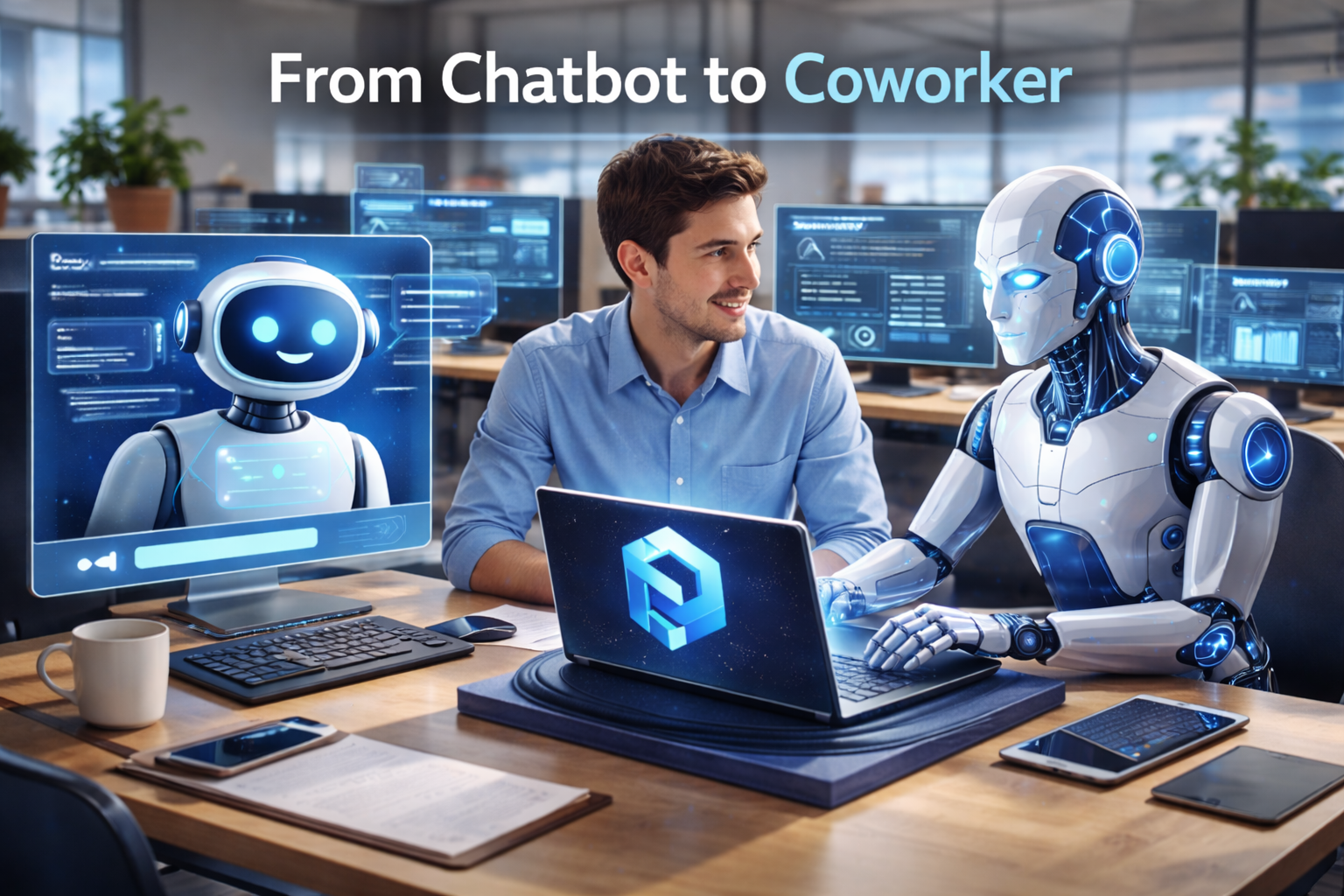
For the last few years, AI has lived mostly in the world of prompts.
You ask.
It answers.
You refine.
It improves.
You copy, paste, edit, adjust.
Even the most advanced AI systems today still depend heavily on humans to connect the dots between outputs. They help. They accelerate. They inspire.
But they don’t own outcomes.
Perplexity Computer aims to change that.
Instead of responding to individual prompts, it is designed to take on entire projects. Not just tasks — projects.
That means:
-
Understanding a long-term objective
-
Breaking it down into smaller actionable steps
-
Assigning those steps to specialized AI models
-
Executing them sequentially
-
Refining and iterating when needed
-
Delivering a finished outcome
In simple terms, it’s trying to function less like a search engine and more like a junior team.
The 19-Model Orchestra
One of the most fascinating aspects of Perplexity Computer is its architecture.
Rather than relying on a single large language model, the system reportedly coordinates around 19 different AI models. Each model has its own specialization:
-
One for reasoning
-
One for coding
-
One for research
-
One for summarization
-
One for visual generation
-
One for analysis
-
And so on
Think of it like an orchestra.
A single violin is impressive.
A full orchestra, under coordination, creates something far more complex.
Perplexity Computer acts as the conductor.
This multi-model orchestration approach is important because it addresses a known limitation of single-model AI systems: generalists struggle with depth in every domain. By dividing labor across specialized models, the system can potentially deliver higher-quality outputs across varied tasks.
This is less chatbot.
More AI operations manager.
So What Can It Actually Do?
Let’s imagine a scenario.
You say:
“I want to launch a niche productivity app for freelancers. Create a strategy, outline the product features, design a basic UI, build a prototype, and prepare a pitch deck.”
With traditional AI, you’d get helpful drafts for each step — but you’d still be orchestrating everything manually.
With Perplexity Computer, the idea is that it could:
-
Conduct market research
-
Analyze competitor products
-
Identify opportunity gaps
-
Draft product specifications
-
Generate wireframes
-
Produce frontend code
-
Assemble documentation
-
Create a presentation deck
-
Refine everything for consistency
And do this with minimal intervention.
If that works as described, we are no longer talking about AI as assistance.
We are talking about AI as execution.
The Big Shift: From Information to Action
Most AI systems today are incredibly good at retrieving and synthesizing information.
But there’s a gap between knowing and doing.
Perplexity built its reputation as an AI-powered answer engine — combining real-time web citations with conversational responses. Now, it seems to be extending that credibility into execution.
This transition is significant.
Information AI → Action AI.
When AI moves from answering to acting, the economic implications expand dramatically.
The Rise of the Digital Worker
The term “digital worker” has been floating around enterprise circles for years. Usually, it referred to automation scripts, robotic process automation (RPA), or workflow bots.
But those systems are rule-based.
They require predefined steps.
Perplexity Computer suggests something different: a goal-driven system.
Instead of telling it how to do something, you tell it what outcome you want.
It figures out the how.
This is closer to hiring a human intern than using a calculator.
And that distinction matters.
Why This Is Technically Ambitious
Building a system like this is far from simple.
Here’s why:
1. Task Decomposition Is Hard
Breaking a vague goal into precise, executable subtasks requires strong reasoning capability.
2. Model Coordination Is Complex
Coordinating multiple AI models means managing:
-
Memory
-
Context
-
Dependencies
-
Output consistency
If one model generates code and another analyzes it, the system must maintain alignment.
3. Long-Term Memory Is Critical
Projects unfold over time. The system must remember earlier decisions and adapt as new information appears.
4. Error Handling Is Essential
What happens if one model fails?
Does the system retry? Revise? Switch approaches?
These challenges suggest that Perplexity Computer isn’t just a product update — it’s an architectural experiment in AI coordination.
Who Benefits Most?
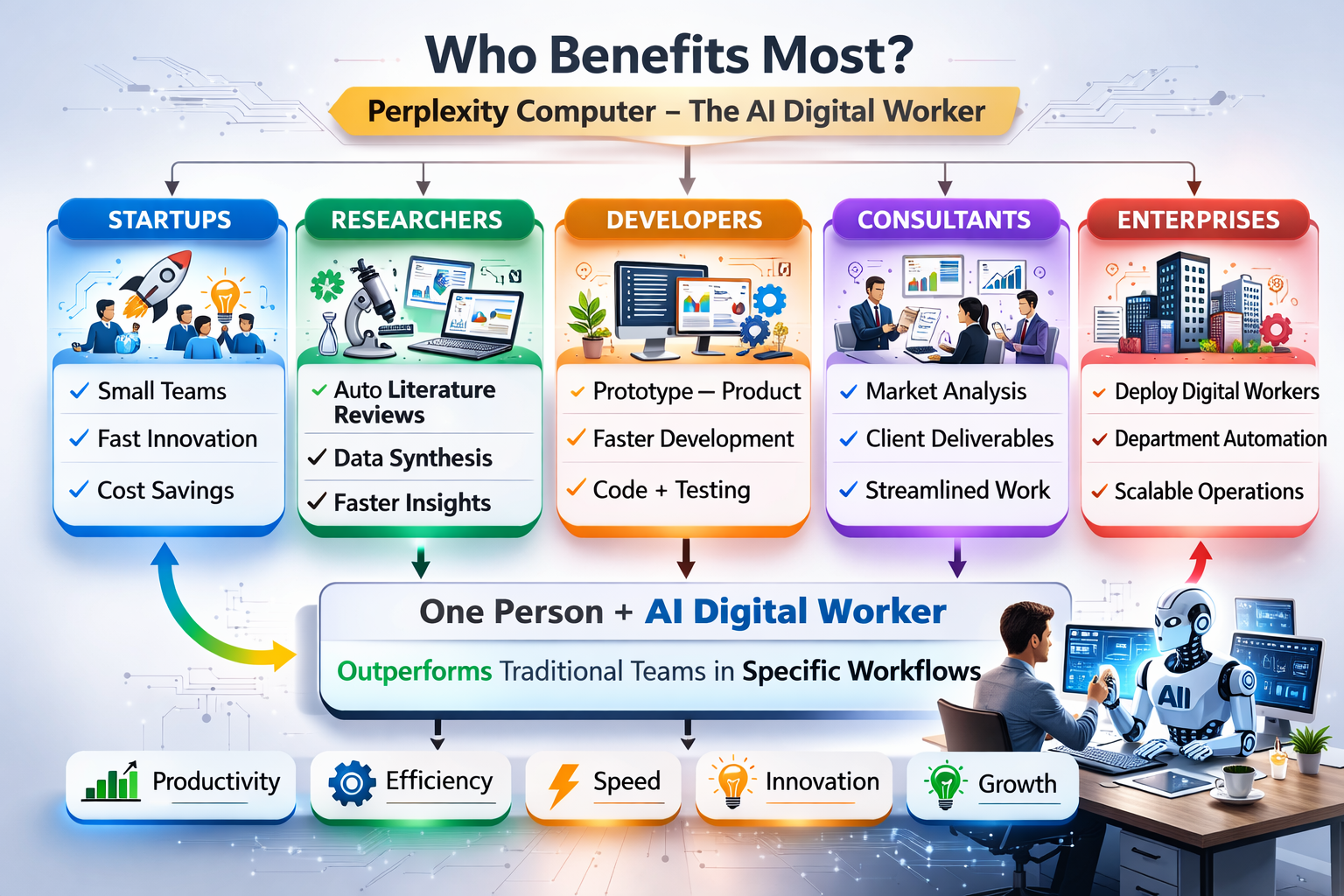
If this works, several groups stand to gain enormously.
Startups
Small teams could accomplish what once required entire departments.
Researchers
Complex literature reviews and data synthesis could be automated at scale.
Developers
Prototype-to-product pipelines might accelerate dramatically.
Consultants
Market analysis and client deliverables could be streamlined.
Enterprises
Large organizations could deploy digital workers for specific departments.
This doesn’t eliminate human expertise — but it changes leverage.
One person plus an AI digital worker could outperform traditional teams in specific workflows.
The Economic Question
Here’s the real tension.
If AI systems can autonomously manage projects, what happens to entry-level roles?
Historically, junior roles served two purposes:
-
Supporting workflow execution
-
Training future senior talent
If AI begins handling structured execution tasks, companies may rethink hiring pipelines.
However, history shows something interesting: automation often shifts jobs rather than eliminating them.
Spreadsheets didn’t eliminate accountants.
They made them more analytical.
The likely scenario?
Humans move toward strategy, creativity, oversight, and judgment — while AI handles structured execution.
But the transition period will be messy.
Why Perplexity Is Making This Move
Perplexity has always positioned itself differently from other AI companies.
While others focused on general conversation, Perplexity emphasized accuracy, citations, and real-time information retrieval.
Launching a digital worker system extends that credibility.
Instead of competing purely on conversational intelligence, Perplexity is stepping into productivity infrastructure.
That’s a strategic move.
It differentiates them in an increasingly crowded AI market.
How This Differs From AI Agents
You may have heard about “AI agents” — systems that browse the web, write code, and perform tasks.
So what’s new here?
The difference lies in orchestration depth and specialization.
Many AI agents rely on a single underlying model performing iterative reasoning loops.
Perplexity Computer reportedly coordinates multiple models in parallel — creating a division of labor.
It’s less like one super-agent.
More like a coordinated digital team.
That architectural choice could be its biggest strength — or its biggest complexity challenge.
The Trust Factor
Here’s the question users will ask:
Can I trust it?
If an AI builds your prototype or conducts your research, how do you verify accuracy?
Perplexity’s reputation for citations may help here. But when AI moves into autonomous execution, transparency becomes critical.
Users will demand:
-
Traceable decisions
-
Clear reasoning logs
-
Editable workflows
-
Human override controls
Without trust, digital workers remain experiments.
With trust, they become infrastructure.
The Bigger Picture: AI as Infrastructure
We are entering a phase where AI is shifting from being a tool to becoming infrastructure.
Just like:
-
Electricity powers buildings
-
Cloud servers power applications
-
APIs power digital services
AI digital workers could power projects.
You don’t think about the electricity grid every time you turn on a light.
In the future, you may not think about the AI layer executing your workflows.
It will simply operate in the background.
That’s the direction Perplexity Computer is pointing toward.
What Happens Next?
Right now, Perplexity Computer is reportedly available to premium subscribers, with broader expansion planned later.
The real test won’t be technical demos.
It will be real-world workflows:
-
Can it handle messy, ambiguous goals?
-
Can it adapt mid-project?
-
Can it maintain consistency across outputs?
-
Can it collaborate with humans effectively?
If yes, this marks a major inflection point.
If no, it becomes a valuable but limited assistant.
Final Thought: We Are Watching a New Category Form
Every major technological shift begins quietly.
The personal computer didn’t start as a cultural revolution.
It started as a hobbyist experiment.
Cloud computing didn’t feel transformative at first.
It felt like outsourced servers.
AI digital workers may feel experimental today.
But if Perplexity Computer succeeds, we won’t look back at this as just another product launch.
We’ll look back at it as the moment AI stopped merely answering questions — and started getting work done.
And once machines begin executing projects independently, the conversation shifts.
Not “What can AI tell me?”
But:
“What can AI build for me?”
That’s a different era.
And it may already be beginning.

 Travel
  Studies
  Food
Food  Fashion
  Technology
  Health





All Comments (0)