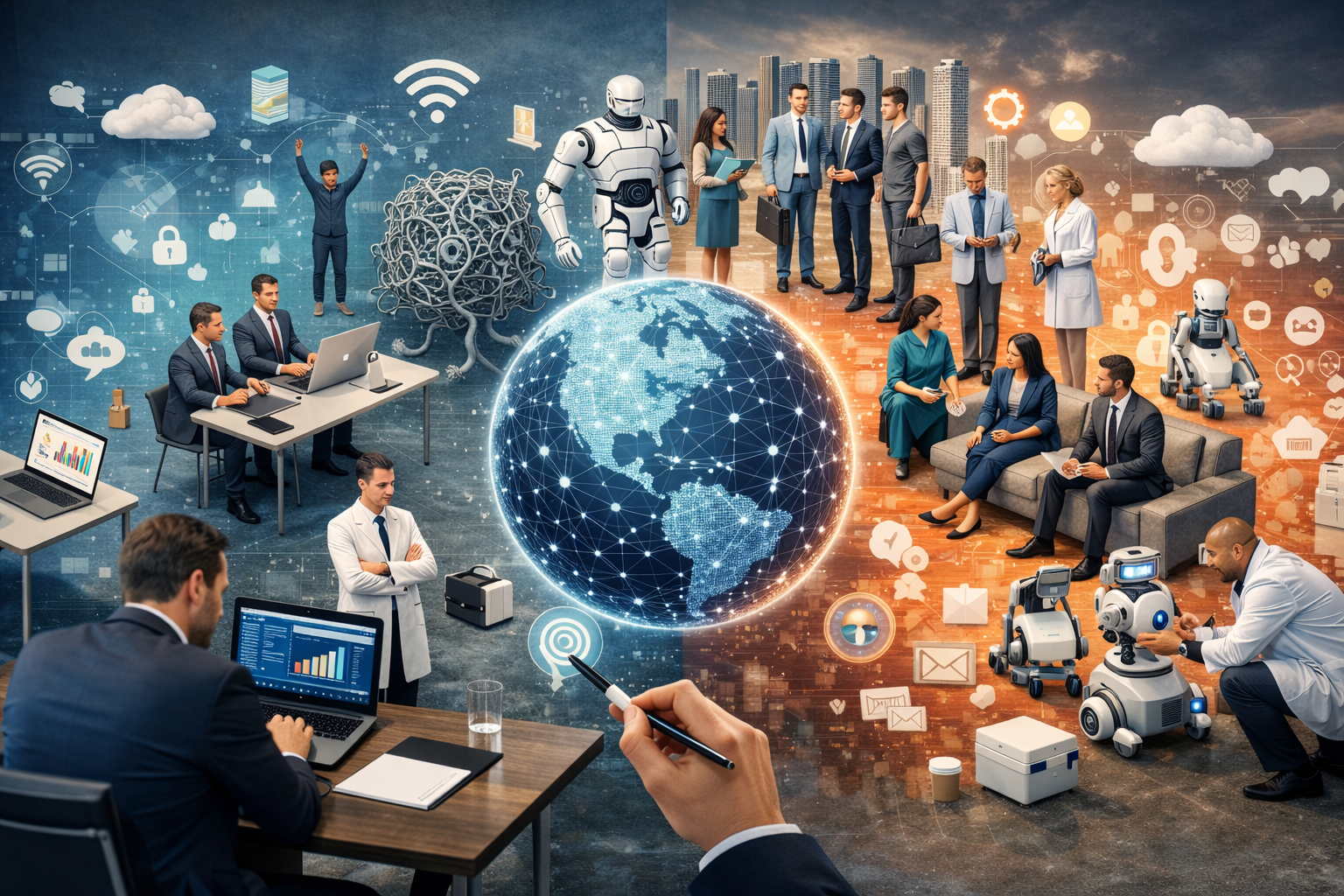

AI is transforming the future of work by enhancing human decision-making rather than replacing it. Leaders like Cisco’s Jeetu Patel emphasize that human judgment and AI together will shape smarter, more productive workplaces.
Artificial Intelligence is no longer a distant concept — it’s a present reality reshaping industries, workplaces, and everyday life. As AI tools grow more capable, a persistent question continues to surface: Will AI replace humans?
According to Jeetu Patel, President and Chief Product Officer at Cisco Systems, the answer is clear: AI will augment human judgment, not replace it.
This perspective is more than a reassuring statement — it reflects a broader shift in how global technology leaders see the future of human-machine collaboration. Rather than eliminating human roles, AI is poised to amplify human intelligence, creativity, and decision-making.
In this blog, we explore what AI augmentation really means, how it will reshape the workforce, and why human judgment remains irreplaceable in an AI-driven world.
Understanding AI Augmentation vs. Replacement
The fear of automation replacing human workers is not new. Every major technological revolution — from industrial machinery to computers — has triggered similar anxieties. However, history shows that innovation tends to transform jobs rather than eliminate human relevance.
AI augmentation means:
-
Machines handle repetitive and data-intensive tasks
-
Humans focus on strategy, creativity, and judgment
-
Technology acts as a productivity multiplier
AI excels at processing enormous volumes of information quickly. It can identify patterns, automate workflows, and generate insights at a scale impossible for humans alone. But it lacks emotional intelligence, ethical reasoning, and contextual awareness — qualities that remain uniquely human.
This partnership creates a powerful synergy: AI provides speed and scale, while humans provide meaning and direction.
Why Human Judgment Cannot Be Replaced
Even the most advanced AI systems operate within predefined models and training data. They do not possess lived experience, empathy, or moral intuition.
Empathy and Human Connection
Care-based professions — healthcare, education, counseling, and leadership — rely heavily on emotional intelligence. People want to feel understood and supported by other humans. AI can simulate conversation, but it cannot genuinely experience compassion.
Context and Nuanced Decision-Making
Human decisions are shaped by culture, ethics, and situational awareness. AI systems may offer recommendations, but interpreting those suggestions requires human judgment. Complex real-world scenarios demand flexibility and intuition that machines cannot replicate.
Ethical Responsibility
Accountability ultimately rests with humans. Organizations must ensure AI is used responsibly, ethically, and transparently. Human oversight acts as a safeguard against unintended consequences.
These factors highlight a critical truth: AI is a tool, not an autonomous authority.
How AI Is Transforming the Modern Workplace
AI is already reshaping how organizations operate. Instead of replacing entire professions, it is redefining roles and workflows.
Automation of Routine Tasks
Administrative and repetitive processes — data entry, scheduling, and reporting — are increasingly automated. This frees employees to focus on higher-value activities such as innovation and problem-solving.
Enhanced Decision Support
AI-powered analytics provide deeper insights into customer behavior, operational efficiency, and market trends. Leaders can make more informed decisions with AI acting as a strategic advisor.
Creativity and Innovation
Generative AI tools enable faster experimentation and idea generation. Designers, writers, and engineers can prototype concepts quickly, accelerating innovation cycles.
New Career Opportunities
As AI adoption grows, entirely new roles are emerging:
-
AI ethics specialists
-
Machine learning engineers
-
Data strategists
-
Human-AI interaction designers
These careers highlight how AI expands opportunities rather than simply eliminating jobs.
The Evolution of AI: From Tools to Intelligent Partners
AI development is entering a new phase. Early AI systems primarily responded to commands or queries. Today’s systems are evolving into autonomous agents capable of executing complex tasks.
Despite this progress, human oversight remains essential. Autonomous AI can streamline operations, but strategic direction and accountability still belong to people.
This evolution signals a shift from AI as a passive assistant to AI as an active collaborator — a digital co-worker that enhances human performance.
Building Trust and Responsible AI Systems
For AI to successfully augment human capabilities, it must be built on a foundation of trust and responsibility.
Infrastructure Challenges
AI systems require powerful computing resources and robust networks. Investing in infrastructure is essential to support scalable and reliable AI deployment.
Security and Privacy
As AI becomes integrated into critical systems, protecting data and ensuring cybersecurity becomes paramount. Strong safeguards are necessary to prevent misuse and vulnerabilities.
Ethical Guardrails
Clear policies and governance frameworks must guide AI development. Transparency, fairness, and accountability are key to maintaining public trust.
Responsible AI ensures that technological progress benefits society as a whole.
The Future Workforce: Skills for an AI-Driven Era
The workforce of tomorrow will demand adaptability and continuous learning. Workers who combine domain expertise with AI literacy will thrive.
Key future skills include:
-
Critical thinking and problem-solving
-
Emotional intelligence and communication
-
Technical fluency with AI tools
-
Ethical reasoning and leadership
-
Creativity and innovation
Rather than competing with machines, humans will collaborate with them. The most successful professionals will view AI as a partner that enhances their capabilities.
A Global Shift Toward Human-AI Collaboration
Across industries, leaders increasingly agree that AI’s greatest potential lies in collaboration, not replacement. Businesses are focusing on hybrid models where human expertise and machine intelligence work together.
This shift represents a new paradigm: success is measured not by how much work machines can do alone, but by how effectively humans and AI can cooperate.
The future belongs to organizations that embrace augmentation — empowering people with advanced tools while preserving the human qualities that drive innovation and trust.
Conclusion: A Complementary Future
AI is transforming the world at an unprecedented pace. Yet its purpose is not to render humans obsolete. Instead, it amplifies what humans do best.
Human judgment — shaped by empathy, ethics, and lived experience — remains irreplaceable. AI enhances productivity, accelerates discovery, and expands creative possibilities, but it cannot replace the essence of human contribution.
The future of work is not a contest between humans and machines. It is a partnership where each complements the other.
As AI continues to evolve, the organizations and individuals who thrive will be those who embrace augmentation, invest in skills, and build systems grounded in trust and responsibility.

 Travel
  Studies
  Food
Food  Fashion
  Technology
  Health




All Comments (0)