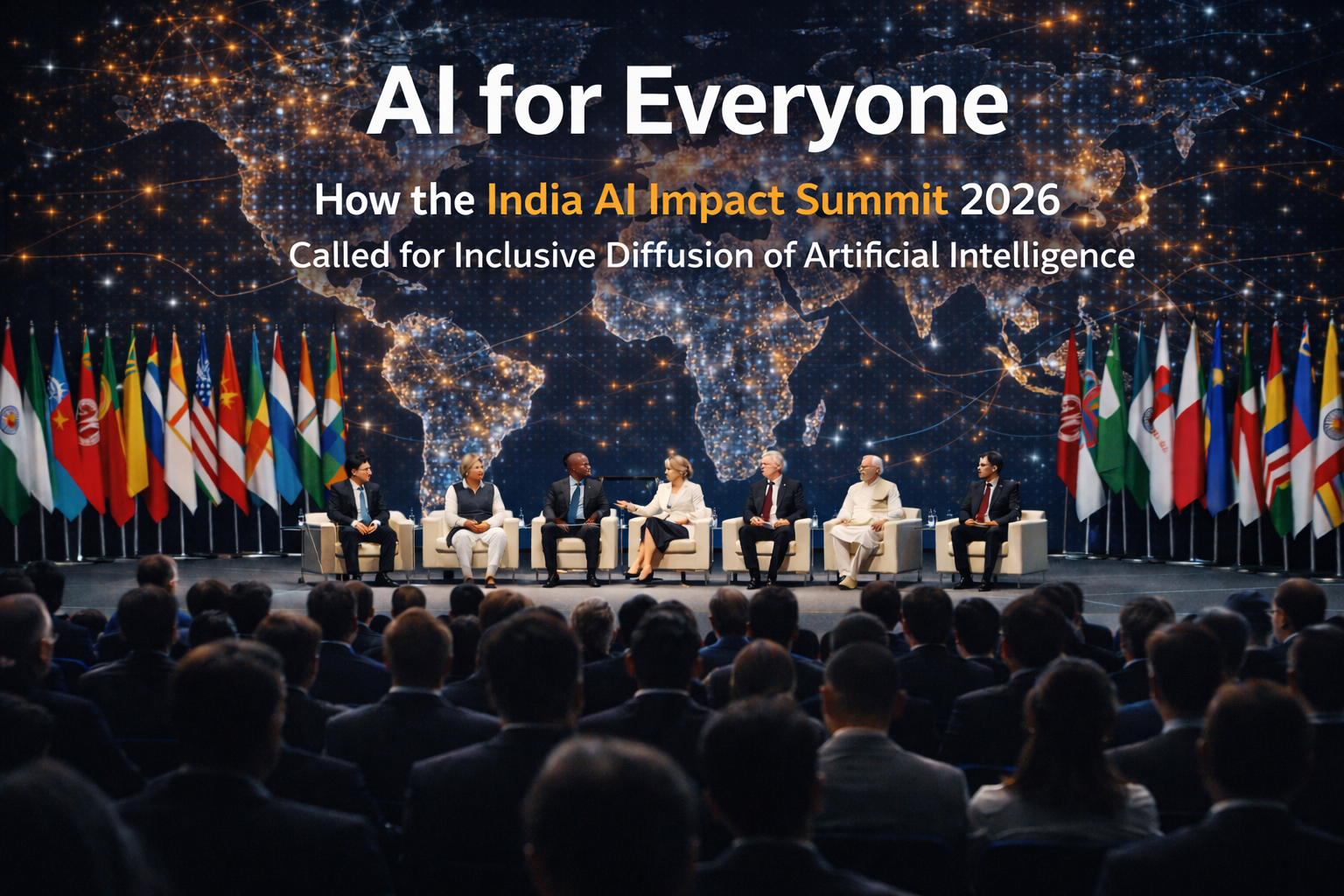

The India AI Impact Summit 2026 in New Delhi marked a defining moment in global technology governance. Bringing together leaders from 88 nations, the summit shifted the AI conversation from competition to cooperation — emphasizing equitable access, ethical innovation, and inclusive diffusion. More than a tech conference, it was a diplomatic milestone that reimagined artificial intelligence as a shared global resource rather than a concentrated advantage.
In a moment that could define the technological arc of this decade, the India AI Impact Summit 2026 brought together global leaders, policymakers, innovators, entrepreneurs, and thinkers in New Delhi to confront one of the most consequential questions of our time: How can the benefits of artificial intelligence be shared equitably across societies, economies, and cultures?
From the outset, the summit signaled that the future of AI would not be shaped solely by market forces or a handful of leading tech companies. Instead, the message resonating throughout the event was clear: the diffusion of AI must accelerate in a way that benefits all people — not just developers, corporations, or wealthy nations.
This call for inclusive diffusion — echoed by leaders from 88 nations and international organisations — marked a significant shift in global AI discourse. It elevated debates about technology from abstract innovation to grounded considerations of access, equity, and societal impact.
A Summit Beyond Technology: Diplomacy, Sovereignty, and Shared Vision
The India AI Impact Summit, held at Bharat Mandapam in New Delhi from February 16 to 20, 2026, was unlike any tech conference India had hosted before. With participation from heads of state, CEOs from global tech giants, startups, and civil society, it became a convergence of diplomacy, governance, and technological ambition.
At the heart of the summit was the New Delhi Declaration, a document endorsed by 88 countries and international organisations. This declaration outlined a shared framework for AI cooperation, emphasising equitable access to AI technologies, responsible innovation, and collaboration on standards that respect national sovereignty and cultural nuance.
The Declaration’s core principles — such as democratising AI resources, building trusted and secure systems, expanding opportunities for science and education, and developing resilient infrastructure — reflected a global consensus that AI should be a force for shared growth rather than concentrated advantage.
This was a profound shift from past gatherings that often centred on cutting-edge research or competition among tech superpowers. Instead, the summit spotlighted AI’s role in advancing social good and sustainable development, echoing global development goals. Although not directly tied to formal United Nations frameworks, the language and concerns — such as energy equity, infrastructure access, and human capital development — reflect the same spirit of inclusive growth championed by international development communities.
From Global North to Global South: Rebalancing the AI Equation
A key theme at the summit was the need to move away from an AI landscape dominated by a few wealthy nations and corporations. Historically, advanced technologies — during both the industrial and digital revolutions — tended to concentrate wealth and expertise in already advantaged regions. AI, with its intense computational requirements and concentrated data resources, threatens to reproduce this pattern unless deliberate policy action intervenes.
India’s hosting of the summit was itself symbolic. As a rapidly developing economy with a booming tech sector, India embodies both the opportunities and challenges of AI diffusion. With its diversity of languages, socioeconomic conditions, and regional disparities, India represents a microcosm of the global challenge: how can AI be inclusive rather than exclusive?
Unveiling four homegrown large language models (LLMs) under the government’s IndiaAI Mission was one demonstration of this ambition. These models — designed with local context and tailored to Indian languages — underscored a commitment to building AI technologies that resonate with local communities and reduce dependence on imported technologies.
Startups also played a vital role. Companies such as Sarvam AI, which developed indigenous models for Indian languages, and Gnani.ai, with multilingual text-to-speech systems, showcased how innovation can reflect cultural reality rather than homogenise it. These efforts both exemplify and enable contextual AI — systems that understand and serve diverse populations.
Such developments don’t just diversify the technical landscape; they lower access barriers for millions of people for whom English-centric systems are less effective. In doing so, they push against the prevailing model where AI advancements are primarily crafted for wealthy, English-speaking markets.
Bridging Gaps: Infrastructure, Skills, and Access
Democratising AI means more than reducing the cost of models — it requires building the digital and human infrastructure necessary to use AI meaningfully.
The summit highlighted several areas where this work is most urgent:
1. Infrastructure and Compute Access
AI systems today demand significant computational power. From data centres to GPUs, the infrastructure required to train and deploy advanced models remains costly. Without widespread access to affordable compute, many countries risk being left behind in the AI revolution.
The New Delhi Declaration acknowledged these challenges, underscoring the importance of expanding infrastructure and connectivity to support broader AI deployment.
2. Human Capital and Workforce Development
Technology without people who can harness it serves little purpose. Speakers at the summit reinforced that effective AI diffusion requires a massive investment in human capital — from early education to advanced reskilling programs.
The idea is not merely to produce coders, but to cultivate a population capable of critically engaging with AI: developers, policymakers, educators, ethicists, and citizens who understand AI’s implications.
3. Trusted and Ethical Systems
Access to AI must also be safe and trustworthy. Discussions throughout the summit stressed building systems with robust security, ethical frameworks, and transparency so societies can adopt AI with confidence.
AI cannot fulfil its promise if concerns about bias, misuse, and opaque decision-making erode public trust. This challenge is especially acute in regions with limited regulatory frameworks or digital literacy.
Small Businesses and Local Innovation: The Real Engine of Inclusive Growth

While much of the summit spotlight was on global strategies and national commitments, another critical conversation emerged around small and medium enterprises (SMEs) and local innovators.
SMEs constitute a massive share of global employment and economic output — particularly in the Global South. Ensuring these businesses can access, understand, and implement AI tools is essential for broad-based economic growth. Without this, AI’s benefits risk accruing only to large enterprises with the resources to adopt emerging technologies.
This focus on SMEs also reframes AI diffusion as not simply a technological challenge but an economic development issue. AI can enable small businesses to automate tasks, analyse market trends, tailor marketing campaigns, improve customer engagement, and streamline operations. These capabilities could boost productivity significantly, particularly in sectors historically slow to digitise.
Moreover, local AI innovation — solutions developed by and for local needs — can create jobs, retain talent, and reduce dependency on imported technologies. This bottom-up approach complements the top-down infrastructure and policy efforts, creating an ecosystem where technology and society evolve together.
Global Cooperation Without Dominance
One of the most striking achievements of the summit was the broad international support for the New Delhi Declaration. With endorsements from nearly 90 countries, the summit reflected a shared commitment to cooperative AI governance — without imposing one nation’s technology stack or standards on others.
This cooperative stance stands in contrast with narratives that see AI as yet another domain of geopolitical rivalry. Instead, the summit’s declaration embodied a vision of multilateralism and shared stewardship, where nations work collaboratively to ensure AI supports sustainable development, public services, and scientific frontiers.
This doesn’t mean the road ahead is easy. Nations differ in their technological maturity, regulatory environments, and development priorities. But creating a common framework based on shared principles — not enforced standards — fosters trust and shared purpose rather than competition and exclusion.
AI for Humanity: Beyond Profit and Hype
Perhaps the most enduring message of the summit was a reminder that AI’s real value lies not in abstract performance metrics or revenue numbers, but in tangible human impact.
AI has the potential to transform healthcare, education, agriculture, disaster response, financial inclusion, and more. But realising these possibilities requires a deep appreciation for contextual needs: languages, cultural practices, economic realities, and social structures.
As summit participants repeatedly emphasised, technology should be an enabler of human potential, not a driver of inequality or exclusion. This human-centric approach isn’t just idealistic — it’s practical. Societies that prioritise inclusive diffusion of AI will likely see more stable adoption, stronger local innovation ecosystems, and greater societal trust in technology.
Looking Forward: A Roadmap for Inclusive AI
The India AI Impact Summit 2026 was not the end of a conversation, but the opening of a new chapter in global AI governance.
The summit’s legacy lies in its principles — inclusive access, shared innovation, ethical design, and collaborative leadership. Translating these into concrete action will require sustained effort:
-
Investments in infrastructure and capacity building, especially in under-served regions.
-
Education and workforce development so citizens can actively participate in the AI economy.
-
Support for local innovation ecosystems, enabling startups and SMEs to thrive.
-
Cross-border partnerships that respect sovereignty while amplifying shared goals.
AI’s promise is immense, but its risks — from bias to unemployment to misuse — are real. Ensuring that AI benefits all will require intentional policies, cooperative frameworks, and a shared commitment to equity.
The summit in New Delhi may have been a milestone, but it is just the beginning of a global effort to build a future where AI empowers every person — not just a privileged few. As the world moves forward, the task will be to expand this vision into measurable outcomes that uplift industries, communities, and lives around the globe.


 Travel
  Studies
  Food
Food  Fashion
  Technology
  Health





All Comments (0)